
In autunno è piacevole passeggiare nei boschi per raccogliere i funghi.
Ma aldilà del rischio multe se beccati senza il patentino, c’è il rischio vero dell’intossicazione e la sicurezza di mangiare un alimento che affatica, vietato ai diabetici per l’alta percentuale di zucchero.
La tradizione Yoga considera i funghi tamasici, cioè con prevalenza di Tamas, o energia allo stato potenziale e ne sconsiglia il consumo ai praticanti…
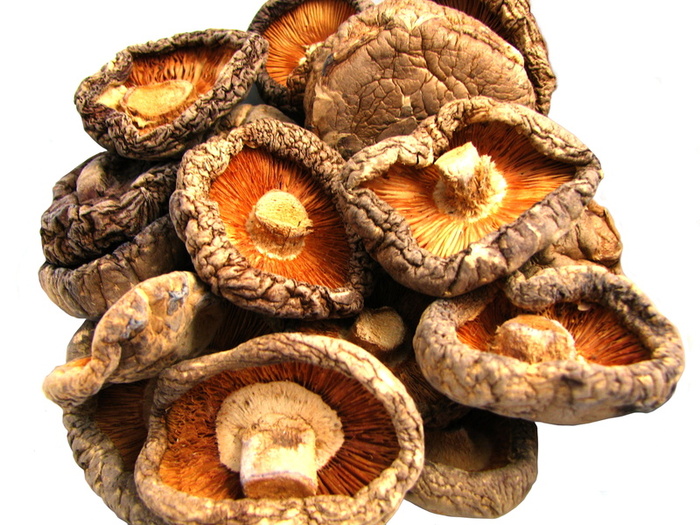
Gli shitake sono funghi giapponesi, il nome si compone di due termini: “shii”, un tipo di quercia e ” take”, fungo, infatti questi funghi crescono spontaneamente sugli alberi e a differenza dei nostri non affaticano il fegato, anzi….lo aiutano a disintossicarsi inoltre rinforzano il sistema immunitario, abbassano il colesterolo e la glicemia.
ecco in dettaglio cosa riporta wikipedia:
Lo shiitake è nutritivo, ricco di proteine (il contenuto di queste corrisponde a circa il 17,5% del totale di materia secca), con nove amminoacidi essenziali. Contiene inoltre sostanze che favoriscono il controllo della pressione arteriosa, la riduzione del livello di colesterolo, il rafforzamento del sistema immunologico e l’inibizione dello sviluppo di tumori, vírus e batteri.
Altre ricerche hanno dimostrato che il Lentinula edodes:
- Stimola il sistema immunitario[2]
- Possiede proprietà antibatteriche[3][4][5]
- Possiede proprietà antivirali[2][6] (anche anti-HIV[7][8][9] e anti-HSV-1[10])
- Contiene inibitore della proteasi[11]
- Ha funzioni ipocolesterolezzanti[12]
- Riduce l’aggregazione delle piastrine[13]
Active Hexose Correlated Compound (AHCC) è un α-glucano isolato dal L. edodes.[14] AHCC è una sostanza ben tollerata[15] che possiete attività antiossidante[16][17], ed è metabolizzato attraverso il percorso CYP450 2D6.[18] Ricerche hanno dimostrato che AHCC possiede le seguenti proprietà:
- Incrementa la resistenza ai patogeni[19][20][21][22][23][24]
- Produce effetti anti-cancro[25][26][27]
- Incrementa la funzione immunitaria[28][29][30]
Il Lentinano, un composto isolato dal L.edodes, viene impiegato come un agente anti tumorale per via endovenosa in alcuni paesi.[31] Studi hanno dimostrato che il lentinano possiede proprietà anti tumorali,[32] e studi clinici hanno associato il Lentinano ad un’aspettativa di vita più alta, una miglior qualità della vita, e ad una bassa incidenza dei tumori.[33][34][35][36][37][38][39][40]
Qui una gustosa ricetta autunnale
http://laspigadigrano.blogspot.it/2011/09/noodle-al-wok-con-verdure-alghe-e.html
Bibliografia
- ^ Alicia Di Rado (26 novembre 2008). Can a mushroom help fight lung cancer? (City of Hope National Medical Center) 7 (11). URL consultato in data 25 giugno 2009.
- ^ a b Yamamoto Y, Shirono H, Kono K, Ohashi Y. (Nov 1997). Immunopotentiating activity of the water-soluble lignin rich fraction prepared from LEM–the extract of the solid culture medium of Lentinus edodes mycelia.. Biosci Biotechnol Biochem 61 (11): 1909–12. PMID 9404070.
- ^ Hirasawa M, Shouji N, Neta T, Fukushima K, Takada K (Feb 1999). Three kinds of antibacterial substances from Lentinus edodes (Berk.) Sing. (Shiitake, an edible mushroom).. Int J Antimicrob Agents 11 (2): 151–7. DOI:10.1016/S0924-8579(98)00084-3. PMID =10221419.
- ^ Tsujinaka T, Yokota M, Kambayashi J, Ou MC, Kido Y, Mori T (1990). Modification of septic processes by beta-glucan administration. Eur Surg Res 22 (6): 340–6. DOI:10.1159/000129120. PMID =2079094.
- ^ Hatvani N (gennaio 2001). Antibacterial effect of the culture fluid of Lentinus edodes mycelium grown in submerged liquid culture.. Int J Antimicrob Agents 17 (1): 71–4. DOI:10.1016/S0924-8579(00)00311-3. PMID 11137653.
- ^ Takehara M, Kuida K, Mori K (1979). Antiviral activity of virus-like particles from Lentinus edodes (Shiitake). Archives of Virology 59 (3): 269–74. DOI:10.1007/BF01317423. PMID 222241.
- ^ Gordon M, Bihari B, Goosby E, Gorter R, Greco M, Guralnik M, Mimura T, Rudinicki V, Wong R, Kaneko Y (1998). A placebo-controlled trial of the immune modulator, lentinan, in HIV-positive patients: a phase I/II trial. J Med 29 (5-6): 305–30. PMID =10503166.
- ^ Tochikura TS, Nakashima H, Yamamoto N (1989). Antiviral agents with activity against human retroviruses.. J Acquir Immune Defic Syndr 2 (5): 441–7. PMID 2477523.
- ^ Suzuki H, Okubo A, Yamazaki S, Suzuki K, Mitsuya H, Toda S (1989). Inhibition of the infectivity and cytopathic effect of human immunodeficiency virus by water-soluble lignin in an extract of the culture medium of Lentinus edodes mycelia (LEM).. Biochem Biophys Res Commun 160 (1): 367–73. DOI:10.1016/0006-291X(89)91665-3. PMID =2469420.
- ^ Sarkar S, Koga J, Whitley RJ, Chatterjee S (1993). Antiviral effect of the extract of culture medium of Lentinus edodes mycelia on the replication of herpes simplex virus type 1. Antiviral Res 20 (4): 293–303. DOI:10.1016/0166-3542(93)90073-R. PMID =8387258.
- ^ Odani S, Tominaga K, Kondou S, Hori H, Koide T, Hara S, Isemura M, Tsunasawa S (1999). The inhibitory properties and primary structure of a novel serine proteinase inhibitor from the fruiting body of the basidiomycete, Lentinus edodes. Eur J Biochem. 262 (3): 915–23. DOI:10.1046/j.1432-1327.1999.00463.x. PMID =10411656.
- ^ Scheda sullo Shiitake
- ^ Shimada S, Komamura K, Kumagai H, Sakurai H (2004). Inhibitory activity of shiitake flavor against platelet aggregation. Biofactors 22 (1-4): 177–9. DOI:10.1002/biof.5520220136. PMID 15630278.
- ^ Spierings EL, Fujii H, Sun B et al. (2007). A Phase I study of the safety of the nutritional supplement, active hexose correlated compound, AHCC, in healthy volunteers. J Nutr Sci Vitaminol 53: 536–539. DOI:10.3177/jnsv.53.536.
- ^ Spierings EL, Fujii H, Sun B, Walshe T (dicembre 2007). A Phase I study of the safety of the nutritional supplement, active hexose correlated compound, AHCC, in healthy volunteers. J. Nutr. Sci. Vitaminol. 53 (6): 536–9. PMID 18202543.
- ^ Ye SF, Wakame K, Ichimura K, Matsuzaki S (marzo 2004). Amelioration by active hexose correlated compound of endocrine disturbances induced by oxidative stress in the rat. Endocr Regul 38 (1): 7–13. PMID 15147233.
- ^ Ye SF, Ichimura K, Wakame K, Ohe M (dicembre 2003). Suppressive effects of Active Hexose Correlated Compound on the increased activity of hepatic and renal ornithine decarboxylase induced by oxidative stress. Life Sci. 74 (5): 593–602. PMID 14623030.
- ^ Mach CM, Fugii H, Wakame K, Smith J (2008). Evaluation of active hexose correlated compound hepatic metabolism and potential for drug interactions with chemotherapy agents. J Soc Integr Oncol 6 (3): 105–9. PMID 19087767.
- ^ Nogusa S, Gerbino J, Ritz BW (febbraio 2009). Low-dose supplementation with active hexose correlated compound improves the immune response to acute influenza infection in C57BL/6 mice. Nutr Res 29 (2): 139–43. DOI:10.1016/j.nutres.2009.01.005. PMID 19285605.
- ^ Wang S, Welte T, Fang H, et al. (marzo 2009). Oral administration of active hexose correlated compound enhances host resistance to West Nile encephalitis in mice. J. Nutr. 139 (3): 598–602. DOI:10.3945/jn.108.100297. PMID 19141700.
- ^ Aviles H, O’Donnell P, Orshal J, Fujii H, Sun B, Sonnenfeld G (aprile 2008). Active hexose correlated compound activates immune function to decrease bacterial load in a murine model of intramuscular infection. Am. J. Surg. 195 (4): 537–45. DOI:10.1016/j.amjsurg.2007.05.045. PMID 18304499.
- ^ Ritz BW (settembre 2008). Supplementation with active hexose correlated compound increases survival following infectious challenge in mice. Nutr. Rev. 66 (9): 526–31. DOI:10.1111/j.1753-4887.2008.00085.x. PMID 18752476.
- ^ Aviles H, O’Donnell P, Sun B, Sonnenfeld G (dicembre 2006). Active hexose correlated compound (AHCC) enhances resistance to infection in a mouse model of surgical wound infection. Surg Infect (Larchmt) 7 (6): 527–35. DOI:10.1089/sur.2006.7.527. PMID 17233570.
- ^ Ritz BW, Nogusa S, Ackerman EA, Gardner EM (novembre 2006). Supplementation with active hexose correlated compound increases the innate immune response of young mice to primary influenza infection. J. Nutr. 136 (11): 2868–73. PMID 17056815.
- ^ Matsui Y, Uhara J, Satoi S, et al. (luglio 2002). Improved prognosis of postoperative hepatocellular carcinoma patients when treated with functional foods: a prospective cohort study. J. Hepatol. 37 (1): 78–86. PMID 12076865.
- ^ Turner J, Chaudhary U (marzo 2009). Dramatic prostate-specific antigen response with activated hemicellulose compound in metastatic castration-resistant prostate cancer. Anticancer Drugs 20 (3): 215–6. DOI:10.1097/CAD.0b013e3283163c26. PMID 19104437.
- ^ Cowawintaweewat S, Manoromana S, Sriplung H, et al. (marzo 2006). Prognostic improvement of patients with advanced liver cancer after active hexose correlated compound (AHCC) treatment. Asian Pac. J. Allergy Immunol. 24 (1): 33–45. PMID 16913187.
- ^ Terakawa N, Matsui Y, Satoi S et al. (2008). Immunological effect of active hexose correlated compound (AHCC) in healthy volunteers: a double-blind, placebo-controlled study. Nutr Cancer 60: 643–51. DOI:10.1080/01635580801993280.
- ^ Gao Y, Zhang D, Sun B, Fujii H, Kosuna K, Yin Z (ottobre 2006). Active hexose correlated compound enhances tumor surveillance through regulating both innate and adaptive immune responses. Cancer Immunol. Immunother. 55 (10): 1258–66. DOI:10.1007/s00262-005-0111-9. PMID 16362410.
- ^ Aviles H, Belay T, Vance M, Sun B, Sonnenfeld G (ottobre 2004). Active hexose correlated compound enhances the immune function of mice in the hindlimb-unloading model of spaceflight conditions. J. Appl. Physiol. 97 (4): 1437–44. DOI:10.1152/japplphysiol.00259.2004. PMID 15194672.
- ^ (2009). Lentinian (Memorial Sloan-Kettering Cancer Center).
- ^ Kim H, Kacew S, Lee B (1999). In vitro chemopreventive effects of plant polysaccharides (Aloe barbadensis miller, Lentinus edodes, Ganoderma lucidum and Coriolus versicolor). Carcinogenesis 20 (8): 1637–40. DOI:10.1093/carcin/20.8.1637. PMID 10426820.
- ^ Yang P, Liang M, Zhang Y, Shen B. (Aug 2008). Clinical application of a combination therapy of lentinan, multi-electrode RFA and TACE in HCC.. Adv Ther. 25 (8): 787–94. DOI:10.1007/s12325-008-0079-x. PMID 18670743.
- ^ Nimura H, Mitsumori N, Takahashi N, (Jun 2006). [S-1 combined with lentinan in patients with unresectable or recurrent gastric cancer]. Gan to Kagaku Ryoho. 33 (1): 106–9. PMID 16897983.
- ^ Nakano H, Namatame K, Nemoto H, Motohashi H, Nishiyama K, Kumada K. (1999). A multi-institutional prospective study of lentinan in advanced gastric cancer patients with unresectable and recurrent diseases: effect on prolongation of survival and improvement of quality of life. Kanagawa Lentinan Research Group.. Hepatogastroenterology. 46 (28): 2662–8. PMID 10522061.
- ^ Oba K, Kobayashi M, Matsui T, Kodera Y, Sakamoto J (luglio 2009). Individual Patient Based Meta-analysis of Lentinan for Unresectable/Recurrent Gastric Cancer. Anticancer Res. 29 (7): 2739–45. PMID 19596954.
- ^ Hazama S, Watanabe S, Ohashi M, et al. (luglio 2009). Efficacy of Orally Administered Superfine Dispersed Lentinan ({beta}-1,3-Glucan) for the Treatment of Advanced Colorectal Cancer. Anticancer Res. 29 (7): 2611–7. PMID 19596936.
- ^ Kataoka H, Shimura T, Mizoshita T, et al. (2009). Lentinan with S-1 and paclitaxel for gastric cancer chemotherapy improve patient quality of life. Hepatogastroenterology 56 (90): 547–50. PMID 19579640.
- ^ Isoda N, Eguchi Y, Nukaya H, et al. (2009). Clinical efficacy of superfine dispersed lentinan (beta-1,3-glucan) in patients with hepatocellular carcinoma. Hepatogastroenterology 56 (90): 437–41. PMID 19579616.
- ^ Shimizu K, Watanabe S, Watanabe S, et al. (2009). Efficacy of oral administered superfine dispersed lentinan for advanced pancreatic cancer. Hepatogastroenterology 56 (89): 240–4. PMID 1945306
Rispondi